
Why Does God Allow Suffering?
A Biblical Answer to Life’s Hardest Question
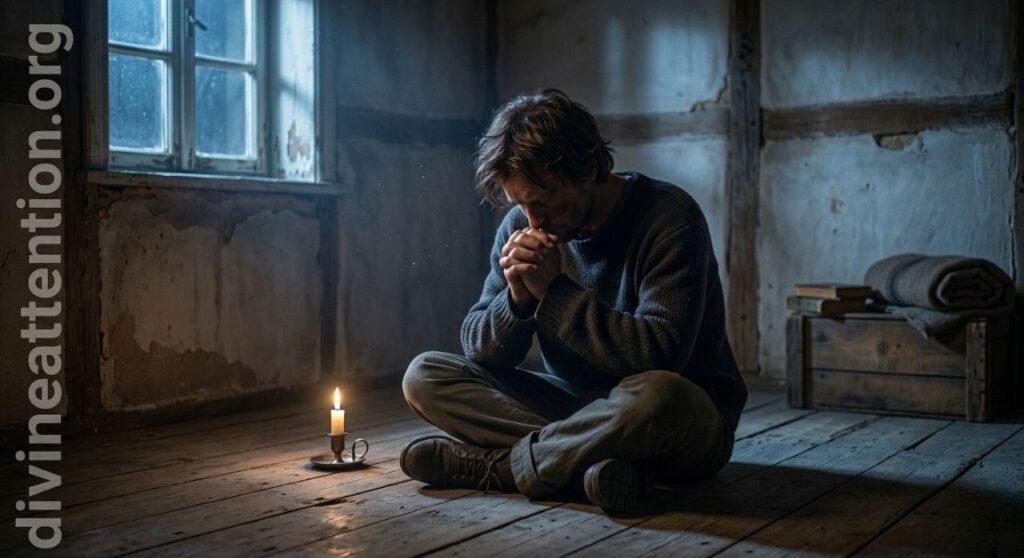
If God is good, why is there pain? If God is all-powerful, why does He not stop the cancer, end the poverty, prevent the abuse, save the child? This is not a new question. It is the oldest question in human history. And the Bible does not dodge it.
Romans 8:18 · James 1:2–4 · 2 Corinthians 4:17 · Job 1–42 · Romans 8:28
| “I consider that our present sufferings are not worth comparing with the glory that will be revealed in us.” Romans 8:18 (NIV) |
The question of suffering is the question that has driven more people away from faith than almost any other. It is also the question that, when answered honestly and biblically, has drawn more people into authentic, deepened faith than almost any other. Because there is something about the problem of pain that refuses to be answered superficially. And the God of the Bible does not offer superficial answers.
The technical name for this question is theodicy – from the Greek theos (God) and dike (justice). How do we justify the ways of God in a world that contains cancer, genocide, child abuse, famine, and natural disasters? If God is both all-powerful and all-good, why does suffering exist? If He can prevent it and does not, is He truly good? If He wants to prevent it but cannot, is He truly powerful?
These are not questions that polite Christianity should sidestep. They are questions that the Bible takes head-on. Job asked them. David asked them. Jeremiah asked them. Habakkuk asked them. Even Jesus cried from the cross: “My God, my God, why have You forsaken Me?” The honest wrestling with suffering is not a sign of weak faith. It is a sign of genuine engagement with the reality of a broken world and a God who claims sovereignty over it.
This sermon will not offer easy answers. But it will offer true ones. And the true answers, held honestly, have sustained the faith of God’s people through every form of human suffering across every generation in every culture that has ever existed.
| WHAT THIS SERMON COVERS 1. Key Bible Verses on Suffering and God’s Goodness 2. How to Use This Sermon 3. Part 1 – What the Bible Does Not Say About Suffering 4. Part 2 – Why Suffering Exists in a World Made by a Good God 5. Part 3 – What God Is Doing in and Through Suffering 6. Part 4 – The Testimony of Job – Suffering Without Easy Explanation 7. Part 5 – The Cross – God’s Ultimate Answer to Suffering 8. Part 6 – How to Respond to Suffering Biblically 9. Declaration of Faith in God’s Goodness 10. Closing Prayer 11. FAQ – Questions About God and Suffering |
How to use this sermon: This message is most powerful for congregations experiencing collective difficulty – bereavement, national crisis, community tragedy, or sustained hardship. Preach it with pastoral sensitivity and intellectual honesty. Avoid easy platitudes. The people who need this message are hurting, and they will know the difference between genuine engagement and religious deflection.
What Does the Bible Say About Suffering?
✔ Romans 8:18 – Present sufferings are not worth comparing with the glory that will be revealed.
✔ James 1:2–4 – Consider it pure joy when you face trials. Testing produces perseverance and maturity.
✔ 2 Corinthians 4:17 – Light and momentary troubles are achieving for us an eternal glory that far outweighs them all.
✔ Romans 8:28 – In all things God works for the good of those who love Him.
✔ John 16:33 – In this world you will have trouble. But take heart! I have overcome the world.
✔ Psalm 34:18 – The Lord is close to the broken-hearted and saves those who are crushed in spirit.
✔ Isaiah 43:2 – When you pass through the waters I will be with you. When you walk through fire you will not be burned.
✔ 2 Corinthians 1:3–4 – God comforts us in all our troubles so that we can comfort those in any trouble.
✔ Romans 5:3‑5 – Suffering produces perseverance, character, and hope – and hope does not put us to shame.
✔ Revelation 21:4 – He will wipe every tear from their eyes. There will be no more death, mourning, or pain.
What the Bible Does Not Say About Suffering
Before examining what the Bible does say about suffering, it is important to clear away what it does not say – because false theological frameworks about suffering cause as much damage as the suffering itself.
The Bible Does Not Say That All Suffering Is God’s Punishment
John 9:1–3 records the disciples asking Jesus whose sin caused a man to be born blind – his or his parents’. Jesus answered: neither. His condition was “so that the works of God might be displayed in him.” This directly dismantles the instinctive human framework that suffering is always the consequence of personal sin. Job’s friends made this mistake and were rebuked by God for it (Job 42:7). While some suffering is the natural consequence of sin, the Bible explicitly and repeatedly refuses to make this a universal principle.
The Bible Does Not Say That Faith Exempts You from Suffering
John 16:33 records Jesus telling His disciples directly: “In this world you will have trouble.” Not might have. Will have. The promise is not exemption from suffering but His presence and victory within it. Hebrews 11 – the Faith Hall of Fame – includes people who were tortured, imprisoned, stoned, and killed, all while maintaining extraordinary faith. Their faith did not prevent the suffering. It sustained them through it.
The Bible Does Not Say That Suffering Means God Has Abandoned You
Psalm 34:18 states: “The Lord is close to the broken-hearted and saves those who are crushed in spirit.” The crushing is where God draws closest, not where He withdraws. Isaiah 43:2 does not promise a path around the waters or the fire. It promises God’s presence through them. The feeling of abandonment in suffering is one of the enemy’s most effective lies. And the cross of Jesus – where the most innocent person who ever lived experienced the most unjust suffering in history – is God’s permanent answer to that lie.
Why Suffering Exists in a World Made by a Good God
Genesis 1 records God surveying His completed creation and declaring it very good. There was no suffering, no death, no pain, no disease, no natural disaster, no predation, and no mourning in the original creation. The world as God designed it was not the world we inhabit. Something went catastrophically wrong.
The Origin of Suffering – The Fall
Romans 8:20–22 describes the cosmic impact of human sin: “For the creation was subjected to frustration, not by its own choice, but by the will of the one who subjected it, in hope that the creation itself will be liberated from its bondage to decay and brought into the freedom and glory of the children of God.” The fall of Genesis 3 did not just affect humanity. It subjected the entire created order to a fundamental disorder – the frustration, decay, and groaning that we experience as the natural world’s suffering alongside us.
The Role of Human Freedom
A significant proportion of human suffering is the direct or indirect result of human choices – war, oppression, injustice, abuse, neglect, and greed. The question “why does God allow this?” is often more accurately the question “why does God allow human freedom?” And the answer is that a world without freedom would be a world without love. Love, by definition, cannot be coerced. The risk of genuine freedom is that it can be used destructively. And across human history, it has been.
The Limits of Our Current Perspective
1 Corinthians 13:12 says: “For now we see only a reflection as in a mirror; we see dimly. But then we shall see face to face. Now I know in part; then I shall know fully, even as I am fully known.” The problem of suffering is partly a problem of limited perspective. We see one chapter of a story whose full arc we cannot yet access. What looks, from inside chapter seven, like an inexplicable tragedy may look, from the final chapter, like the necessary setup for the most extraordinary redemption in the story. We are not yet in a position to evaluate the whole story from inside the chapter we are living.
| “And we know that in all things God works for the good of those who love Him, who have been called according to His purpose.” Romans 8:28 (NIV) |

What God Is Doing in and Through Suffering
Romans 8:28 is simultaneously one of the most comforting and most challenging verses in Scripture: “In all things God works for the good of those who love Him.” Not some things. Not the things that make sense. All things. Including the things that seem senseless, cruel, and incomprehensible. This does not mean all things are good. It means that God, in His sovereignty and love, is working even in and through the things that are genuinely terrible to produce outcomes that are genuinely good.
1. Suffering Produces Spiritual Depth and Maturity
James 1:2–4 is direct: the testing of faith produces perseverance, and perseverance its complete work, so that you may be mature and complete, lacking nothing. The deepest, most stable, most fruitful believers in every generation are almost always those who have survived the most significant seasons of difficulty. Not because suffering is pleasant but because it does a work in the soul that prosperity cannot do. It drives roots deep. It destroys shallow attachments. It reveals what is truly foundational.
2. Suffering Creates Genuine Compassion for Others
2 Corinthians 1:3‑4 reveals one of the most redemptive purposes of personal suffering: “God comforts us in all our troubles so that we can comfort those in any trouble with the comfort we ourselves receive from God.” The person who has never suffered cannot genuinely comfort the person who is suffering. The counsellor who has walked through grief carries something that the counsellor who has only studied grief does not. Personal suffering, brought to God and processed through His grace, becomes the raw material for extraordinary ministry to others.
3. Suffering Reveals What We Are Made Of
Peter describes various trials as “proven genuine” faith – like gold refined in fire (1 Peter 1:6–7). The refining process does not create the gold. It reveals it – burning away everything that is not gold so that what is genuine and lasting comes to the surface. Suffering does not create character. It reveals character. And in the process, the believer discovers dimensions of God’s faithfulness and their own resilience that comfortable seasons never show.
4. Suffering Positions for Greater Glory
2 Corinthians 4:17 uses a word that can only be appreciated in the original Greek: the “eternal weight of glory” that suffering is producing is described with a word that means disproportionately, immeasurably beyond all comparison. The suffering of this present season is not just being balanced by future glory. It is being used to produce a weight of glory that is exponentially greater than itself. The exchange rate of eternity transforms the calculation entirely.
The Testimony of Job – Suffering Without Easy Explanation
The book of Job is Scripture’s most extended and most honest engagement with the problem of suffering. Job was described by God Himself as “blameless and upright, a man who fears God and shuns evil” (Job 1:8). And he suffered catastrophically. His children died. His wealth was destroyed. His health collapsed. His wife told him to curse God and die. His friends insisted that his suffering must be punishment for hidden sin.
Every one of Job’s friends was wrong. And God said so explicitly (Job 42:7). Job’s suffering was not caused by his sin. It was not God’s punishment. And at the end of the book, after God speaks to Job from the whirlwind (Job 38–41), Job does not receive an explanation of why it happened. He receives a revelation of who God is. And that revelation is sufficient.
| THE LESSON OF JOB: The book of Job does not answer the question of why a specific person suffers a specific suffering. It answers the question of how. How do you maintain faith when there is no explanation? By holding onto the God who is bigger than the explanation. Job never learned why. But he encountered Who. And the Who was more than enough to restore, multiply, and carry him through to the other side. The final chapter of Job is a testimony to the God who restored everything that was lost – and then some. The last state of Job was greater than his first. |
The Cross – God’s Ultimate Answer to Suffering
The definitive answer to the problem of suffering is not an argument. It is a Person. And that Person is hanging on a cross outside Jerusalem, bearing the weight of every sin ever committed, experiencing the full depth of human abandonment, pain, and death – and doing it willingly, out of love, to accomplish what nothing else could accomplish.
The cross does not explain every specific suffering. But it answers the deepest question underneath every specific suffering: Is God good? Does He care? Is He with us in the pain? The cross is God’s permanent, irreversible, covenant answer to those questions. He did not watch suffering from a safe distance and offer theological commentary. He entered it. He experienced it. He was crushed by it. And He walked out the other side to prove that it does not have the final word.
Romans 8:32 frames it with devastating logic: “He who did not spare His own Son, but gave Him up for us all – how will He not also, along with Him, graciously give us all things?” The cross is the evidence of what God is willing to do for His people. Anyone who questions whether God is good in the middle of their suffering can stand at the cross and ask the question again. The answer is nailed there permanently.

How to Respond to Suffering Biblically
1. Bring the Honest Pain to God
The psalms of lament give the believer full permission to bring their raw, honest experience before God without religious packaging. Psalm 22, Psalm 88, and Lamentations are entirely composed of honest complaint, grief, and confusion directed at God. This is not faithlessness. It is faith that is honest enough to say: I do not understand this, and I am bringing my incomprehension to the One who does. Suppressed grief does not heal. It surfaces later in more destructive forms. Bring it to God.
2. Resist the Temptation to Draw Premature Conclusions
James 5:11 says: “You have heard of Job’s perseverance and have seen what the Lord finally brought about.” The key word is finally. The final chapter of Job was restoration and multiplication. But the middle chapters were devastation. You cannot assess God’s faithfulness from inside the middle chapters. Wait for the final chapter. Resist the temptation to make permanent conclusions from temporary pain.
3. Find the Community That Will Carry You
Galatians 6:2: “Carry each other’s burdens, and in this way you will fulfil the law of Christ.” Suffering is not designed to be borne in isolation. The local church exists, among other reasons, to be the community that gathers around those in seasons of suffering and carries what they cannot carry alone. Isolation in suffering is one of the enemy’s most effective strategies. Resist it by staying connected.
4. Allow Suffering to Do Its Formative Work
James 1:4 says: “Let perseverance finish its work so that you may be mature and complete, not lacking anything.” The word “let” implies an active cooperation with what the suffering is producing. The believer who is fighting the suffering, demanding it end immediately, and refusing to find God in the middle of it, is resisting the formative work that God is doing through it. Cooperate. Ask what God is building. And let the perseverance do its necessary work.
| 🔥 DECLARATION OF FAITH IN GOD’S GOODNESS SPEAK THIS WHEN SUFFERING THREATENS TO SHAKE YOUR FAITH My God is good – even in this. He has not abandoned me – He walked this same road on a cross and came out the other side. My present suffering is not worth comparing with the glory that will be revealed. In all things – including this thing – God is working for my good. He is close to me right now, even in the breaking. He sees. He knows. He cares. And He has not finished the story yet. I will not make permanent conclusions from temporary pain. My last chapter has not been written. And the God who is writing it is good. In the name of Jesus Christ. Amen! |
| CLOSING PRAYER Father, I bring the honest weight of what I am going through before You right now. I do not fully understand it. I will not pretend that I do. But I bring it to You because You are the God who entered suffering Yourself, who knows it from the inside, and who promised to be close to the broken-hearted. Be close to me now. Work in this situation for my good and Your glory. Give me the grace to let perseverance do its work. Give me the community to help carry what is too heavy to carry alone. And hold my faith when my feelings are shaking it. I choose to trust You even when I do not understand You. In the name of Jesus. Amen! |
| FREQUENTLY ASKED QUESTIONS ABOUT GOD AND SUFFERING If God is all-powerful, why does He not just stop all suffering? This question assumes that the elimination of all suffering would automatically be the greatest good. But Scripture suggests that a world without suffering would also be a world without freedom, without love, without genuine faith, and without the extraordinary depth of character and compassion that suffering produces. Revelation 21:4 promises that the day is coming when God will wipe every tear from every eye and there will be no more death, mourning, or pain. That day is certain. But the path to it runs through a world in which human freedom, the consequences of sin, and the formative purposes of suffering all play a role in the story that God is writing. He will end suffering completely. But in His timing and by His method. Why does God seem to allow innocent children to suffer? This is perhaps the most painful dimension of the suffering question and deserves honest engagement rather than easy answers. The suffering of innocent children is one of the most visceral challenges to faith in a good God. Scripture does not offer a simple explanation. What it offers is a God who declared of children that their angels always see His face (Matthew 18:10), who had a specific and tender relationship with children throughout His earthly ministry, and who promises that every tear will be wiped away. The suffering of the innocent is not resolved by argument. It is ultimately resolved by resurrection – the promise that no innocent suffering has the final word. Can God use suffering for good even when it is caused by human sin or evil? Yes – and Genesis 50:20 is the clearest biblical illustration of this. Joseph said to his brothers who had sold him into slavery: “You intended to harm me, but God intended it for good to accomplish what is now being done.” The evil was real. The harm was real. The suffering was real. And God worked through and in spite of all of it to produce an outcome that saved a nation. Romans 8:28 does not promise that all things are good. It promises that God works all things – including evil done against us – for the good of those who love Him. This is not a magic formula but a covenant promise that has been demonstrated across Scripture and across the testimonies of God’s people throughout history. How do I help someone who is suffering without offering empty platitudes? The most powerful thing you can do for someone in acute suffering is to be present without an agenda to fix or explain. Job’s friends did their best work in the first seven days when they sat with him in silence and said nothing (Job 2:13). Their theology may have been wrong but their presence was right. When you do speak, lead with acknowledgement of the pain rather than explanation of it. Ask what they need rather than assuming. Resist the temptation to find the silver lining too quickly. And pray with them and for them specifically and persistently. The ministry of presence is often more powerful than the ministry of explanation. Is it wrong to be angry at God when I am suffering? No – and the psalms of lament make this clear. Psalm 88 ends without resolution – it is entirely composed of complaint and does not arrive at a confident conclusion. Habakkuk argued with God for two chapters before receiving divine response. Job argued with God and was commended for speaking what was right (Job 42:7) while his friends who offered tidy theological explanations were rebuked. God is not threatened by honest anger. He is, however, asking for the anger to be brought to Him rather than directed away from Him. The believer who brings their honest anger to God in prayer is maintaining relationship even in the pain. That relationship is the beginning of the healing. |
He Has Not Finished the Story
Romans 8:18 makes a comparison that can only be made by someone who can see the end from the beginning: “I consider that our present sufferings are not worth comparing with the glory that will be revealed in us.” Paul is not minimising the suffering. He is placing it in the only framework large enough to hold it honestly – the framework of eternity.
Your suffering is real. The pain is real. The questions are real. And God is not offended by any of them. But the final chapter of your story has not been written yet. And the Author of that story has demonstrated, at the cross and through the resurrection, exactly what He is capable of doing with the worst possible situation. He specialises in resurrection. He excels at redemption. And He has not finished with your story yet.
🔥 Related Prayer Points


| SHARE THIS MESSAGE Share this with every person in your circles who is struggling to reconcile their pain with their faith in a good God. The honest biblical engagement with suffering can be the very thing that saves their faith. 🔥 Drop a comment below – share how this message has impacted your life! |
Leave a Reply