
The Armour of God: How to Stand Firm in Spiritual Warfare
Are you under spiritual attack right now? Are you sensing unusual pressure, resistance, and opposition in every area of your life at once? You have not been abandoned. You have been targeted. And God has already provided the complete armour you need to stand firm, resist the enemy, and remain standing when every attack has ended.
Ephesians 6:10–18 · 2 Corinthians 10:3–5 · 1 Peter 5:8–9 · Revelation 12:11 · James 4:7
| “Finally, be strong in the Lord and in His mighty power. Put on the full armour of God, so that you can take your stand against the devil’s schemes.” Ephesians 6:10–11 (NIV) |
Every believer is in a war. This is not metaphor. It is not religious language. It is the most literal statement that can be made about the life of anyone who has placed their faith in Jesus Christ. The moment you were born again, you stepped onto a battlefield that has been contested since before human history began. And the enemy you face is not flesh and blood.
Ephesians 6:12 is one of the clearest diagnostic statements in all of Scripture: “For our struggle is not against flesh and blood, but against the rulers, against the authorities, against the powers of this dark world and against the spiritual forces of evil in the heavenly realms.” Your marriage problems are not just marital. Your financial pressure is not just economic. Your health crisis is not just medical. There is a spiritual dimension to every significant human struggle that must be addressed spiritually as well as practically.
The good news is that Paul does not open Ephesians 6 with a diagnosis of the problem and leave you without a solution. He immediately moves to God’s provision: “Put on the full armour of God.” Not some of it. The full armour. Every piece has a specific function. Every piece addresses a specific form of attack. And together they constitute a complete spiritual covering that enables the believer to “stand your ground, and after you have done everything, to stand.” (Ephesians 6:13)
This sermon will take you through every piece of the armour of God, explain exactly what spiritual attack each piece is designed to counter, and show you how to put on the armour practically in your daily life.
| WHAT THIS SERMON COVERS 1. Key Bible Verses on Spiritual Warfare 2. How to Use This Sermon 3. The Context – Why Paul Wrote Ephesians 6 4. The Enemy’s Strategy – Understanding How He Attacks 5. Piece 1 – The Belt of Truth 6. Piece 2 – The Breastplate of Righteousness 7. Piece 3 – The Shoes of the Gospel of Peace 8. Piece 4 – The Shield of Faith 9. Piece 5 – The Helmet of Salvation 10. Piece 6 – The Sword of the Spirit 11. The Weapon Paul Added – All-Kinds-of-Prayer 12. Declaration – Putting On the Full Armour of God 13. Closing Prayer 14. FAQ – Questions About Spiritual Warfare |
How to use this sermon: Teach this as a single complete sermon on spiritual warfare, or as a six-week series with one piece of armour per week. This message is especially powerful at the start of a new season, a new year, or whenever a congregation is under unusual corporate attack. Close with the Declaration so people can put on their armour corporately and audibly.
What Does the Bible Say About Spiritual Warfare?
✔ Ephesians 6:10–18 – The complete armour of God passage. The primary text for this sermon.
✔ 2 Corinthians 10:3–5 – The weapons of our warfare are not carnal but mighty through God for pulling down strongholds.
✔ 1 Peter 5:8–9 – Your adversary the devil prowls around like a roaring lion, seeking someone to devour.
✔ James 4:7 – Submit to God. Resist the devil and he will flee from you.
✔ Revelation 12:11 – They overcame him by the blood of the Lamb and the word of their testimony.
✔ Romans 8:37 – In all these things we are more than conquerors through Him who loved us.
✔ Colossians 2:15 – Having disarmed the powers and authorities, God made a public spectacle of them through the cross.
✔ Luke 10:19 – I have given you authority to trample on serpents and scorpions and to overcome all the power of the enemy.
The Context – Why Paul Wrote Ephesians 6
Ephesians is Paul’s most comprehensive letter about the believer’s position in Christ. Chapters 1 through 3 establish the theological foundation: who the believer is in Christ, seated in heavenly places, blessed with every spiritual blessing. Chapters 4 through 6 apply that foundation to daily life. And the letter ends with Ephesians 6 – because Paul understood that the moment you begin to walk in the fullness of who you are in Christ, the enemy’s opposition will intensify.
The armour of God is not for the spiritually weak. It is for the spiritually advancing. The believer who is pressing into their identity in Christ, growing in prayer, standing in faith, and advancing the Kingdom is exactly the person the enemy targets most aggressively. The armour is God’s provision for the believer who is moving forward.
| THE POSITIONING PRINCIPLE: Ephesians 6:13 says after putting on the full armour of God, you will be able to “stand your ground, and after you have done everything, to stand.” Notice: the goal is not to advance in every season. Sometimes the spiritual assignment is simply to stand. To not give up ground. To not be moved. To resist and remain. Standing firm in a fierce season of spiritual attack is not passivity. It is one of the most active and demanding things a believer can do. |
How the Enemy Attacks – Understanding His Methods
Before you can effectively use the armour, you need to understand what the armour is protecting against. 2 Corinthians 2:11 says that believers should not be “unaware of his schemes.” The word translated schemes is the Greek word noemata – mind-strategies, calculated plans. The enemy is not random. He is strategic.
1 Peter 5:8 – Two Images of the Enemy
1 Peter 5:8 gives two images: the devil “prowls around like a roaring lion” and is “seeking someone to devour.” A roaring lion is not being subtle. The loud attack is designed to produce fear and paralysis. But the letter also describes him as prowling – patient, opportunistic, looking for the right moment, the vulnerable season, the unguarded area. Both tactics require armour.
The Three Channels of Attack
John 10:10 identifies the enemy’s three primary assignments: to steal, to kill, and to destroy. These are not three different enemies. They are three dimensions of one enemy’s operation. He steals first – peace, joy, faith, relationships, identity. When stealing succeeds, he moves to kill – vision, hope, spiritual life, physical health. When killing continues unchallenged, destruction follows. The armour of God is specifically designed to intercept at the steal stage, before the progression reaches its full destructive intent.
The Belt of Truth – Ephesians 6:14
“Stand firm then, with the belt of truth buckled around your waist.” The belt in Roman armour was not a decorative accessory. It was the foundation piece. Every other piece of armour was attached to and supported by the belt. The soldier who lost his belt in battle was immediately vulnerable in every other area. Paul intentionally places truth as the first piece because it is the foundation on which all other spiritual defence rests.
The enemy’s primary weapon is deception. Jesus called him the father of lies (John 8:44). Every significant attack the enemy launches begins with a lie. A lie about who God is. A lie about who you are. A lie about what your situation means. A lie about whether God sees, cares, or can intervene. The belt of truth is the commitment to God’s Word as the non-negotiable standard of reality – the refusal to let feelings, circumstances, or the enemy’s suggestions override what the Word of God says.
How to Buckle the Belt of Truth Daily
Buckling the belt of truth means beginning every day by deliberately affirming what God says about your identity, your situation, and your future – specifically over and against what your feelings or circumstances are saying. It means reading the Word before any other input enters your mind. It means knowing the promises of God well enough to recognise the lie when it arrives.
The Breastplate of Righteousness – Ephesians 6:14
The breastplate covered the vital organs – most critically the heart. In biblical imagery, the heart is not just the emotional centre but the centre of will, desire, and moral decision-making. The breastplate of righteousness is God’s protection over the moral and motivational core of the believer.
There are two dimensions of righteousness in Scripture: imputed righteousness – the righteousness of Christ credited to the believer through faith (2 Corinthians 5:21) – and practical righteousness – the actual moral choices made in daily living. Both dimensions are relevant to the breastplate. The enemy targets both: he attacks through condemnation (trying to make the believer doubt their standing before God) and through temptation (trying to introduce moral compromise that creates real vulnerability).
The Enemy’s Access Through Moral Compromise
One of the most significant truths about spiritual warfare is that deliberate, unrepented sin gives the enemy legal ground in a believer’s life. Ephesians 4:27 warns: “Do not give the devil a foothold.” The Greek word for foothold is topos – a place, a territory. When moral compromise is entertained and not repented of, the enemy is given territory in that area of life from which he can operate with a degree of authority. The breastplate of righteousness is maintained through ongoing repentance, clean hands, and a pure heart.
| “For our struggle is not against flesh and blood, but against the rulers, against the authorities, against the powers of this dark world and against the spiritual forces of evil in the heavenly realms.” Ephesians 6:12 (NIV) |
The Shoes of the Gospel of Peace – Ephesians 6:15
Roman soldiers wore hobnailed sandals with heavy soles that gave them traction and stability on uneven ground. The soldier who lost his footing in battle was immediately vulnerable. Paul identifies the shoes as the gospel of peace – and the image is of a believer who is firmly planted, not easily moved, not scrambling for footing when the spiritual ground shifts.
The gospel of peace gives the believer stable footing in two directions: peace with God (the objective reality of reconciliation through the cross) and the peace of God (the subjective experience of calm in the middle of warfare). Philippians 4:7 describes this second dimension as the peace that surpasses understanding guarding hearts and minds. A believer who is at peace internally cannot be destabilised by external chaos. The enemy’s strategy of creating confusion, panic, and anxiety to destabilise believers is directly countered by the shoes of peace.
The Shield of Faith – Ephesians 6:16
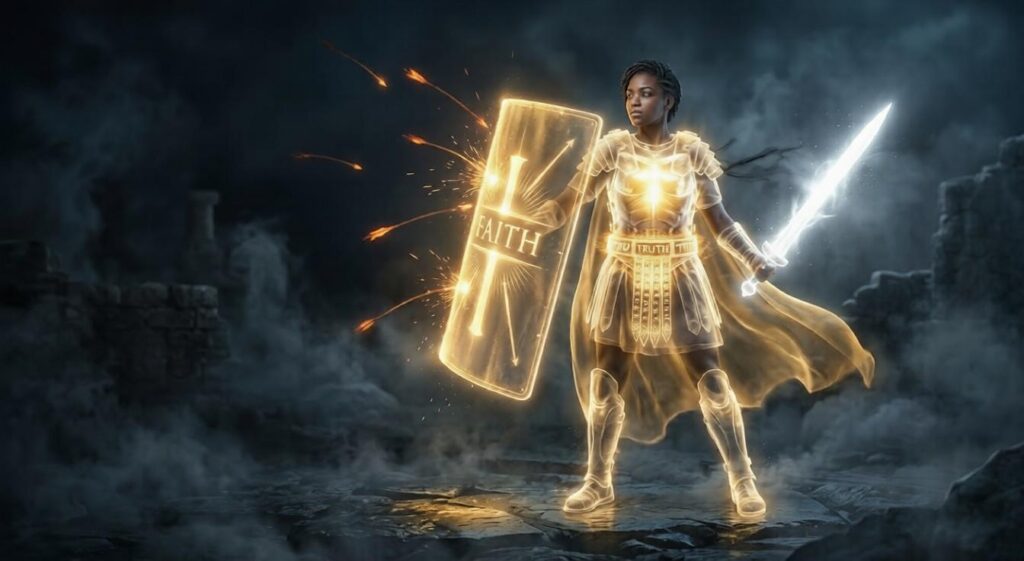
Ephesians 6:16 specifies: “In addition to all this, take up the shield of faith, with which you can extinguish all the flaming arrows of the evil one.” The word translated shield in Greek is thureos – the large, full-body shield used by Roman infantry, not the small round shield of individual combat. It covered the whole body. And Paul says it extinguishes all the flaming arrows – not some, not most, all.
The flaming arrows are not random. They are targeted thoughts, doubts, fears, and suggestions delivered at strategic moments of vulnerability: when you are tired, grieving, isolated, or facing sustained pressure. These are not just negative thoughts. They are fiery projectiles – designed to ignite and spread through the mind if they land unextinguished. Faith – specifically the active, daily, confessed choice to believe God’s Word over the arrow’s message – is the extinguisher.
| HOW THE SHIELD WORKS: The shield of faith is not passive belief. It is active, declared, confessed trust in God’s specific promises applied to specific attacks. When the flaming arrow of financial fear arrives, the shield is the spoken declaration of Philippians 4:19. When the arrow of sickness arrives, the shield is Isaiah 53:5 confessed aloud. When the arrow of discouragement arrives, the shield is Isaiah 40:31 spoken with faith. The shield is specific, responsive, and voice-activated. You raise it by speaking God’s Word. |

The Helmet of Salvation – Ephesians 6:17
The helmet protects the head – and in spiritual terms, the mind. Isaiah 59:17 describes God Himself putting on the helmet of salvation. The helmet is the protection of the believer’s thought life from the enemy’s most persistent and most successful form of attack: the assault on the mind.
The enemy cannot read your thoughts, but he can project thoughts into your mind – thoughts that feel like your own but originate from him. Thoughts of hopelessness, worthlessness, doubt, fear, and condemnation. The helmet of salvation is the ongoing assurance of the believer’s standing in Christ – the security of knowing that you are saved, sealed, and secure in Christ regardless of how you feel. 2 Corinthians 10:5 connects this directly to spiritual warfare: “We take captive every thought to make it obedient to Christ.”
Taking Thoughts Captive
Taking thoughts captive is not simply rejecting negative thoughts. It is replacing them with specific biblical truth. The helmet of salvation is renewed daily through Romans 12:2: be transformed by the renewing of your mind. Every lie identified, named, and replaced with its specific scriptural contradiction is a thought taken captive and made obedient to Christ.
The Sword of the Spirit – Ephesians 6:17
The sword is the only offensive weapon in the armour. Every other piece is defensive. The sword of the Spirit – which Paul defines as the Word of God – is the weapon with which the believer takes the fight to the enemy rather than simply absorbing attacks.
The Greek word for Word here is rhema – not logos (the written Word in general) but rhema (the specific, spoken, Spirit-breathed Word applied to a specific situation). Jesus modelled this perfectly in the wilderness temptation of Matthew 4: for each of Satan’s three attacks, He responded with a specific, targeted scripture spoken aloud. The sword is not passive Bible reading. It is the Spirit-directed, voice-activated application of a specific scripture to a specific spiritual assault.
How to Sharpen the Sword
A soldier who has never trained with their sword cannot use it effectively in battle. The sharpness of the sword of the Spirit in a believer’s life is directly proportional to the depth and consistency of their engagement with the Word of God. Hebrews 4:12 describes the Word as alive, active, sharper than any double-edged sword. The more saturated a believer is in Scripture, the more readily the Spirit can bring the right word at the right moment in the middle of spiritual battle.
All-Kinds-of-Prayer – Ephesians 6:18
Ephesians 6:18 adds a crucial weapon that is not physically part of the armour but without which all the other pieces are ineffective: “And pray in the Spirit on all occasions with all kinds of prayers and requests. With this in mind, be alert and always keep on praying for all the Lord’s people.”
Prayer is the atmosphere in which the armour functions. You do not dress for spiritual warfare and then sit quietly. You dress and you pray. The Greek phrase translated “all kinds of prayers” encompasses supplication, intercession, thanksgiving, petition, and praying in the Spirit (tongues). Paul’s instruction is total: all occasions, all kinds, always. Spiritual warfare is fundamentally a prayer war. Every other piece of armour is engaged and maintained through the weapon of persistent, Spirit-led prayer.
| “They triumphed over him by the blood of the Lamb and by the word of their testimony; they did not love their lives so much as to shrink from death.” Revelation 12:11 (NIV) |
| 🔥 DECLARATION – PUTTING ON THE FULL ARMOUR OF GOD PRAY THIS EVERY MORNING AS YOUR DAILY SPIRITUAL DRESSING I put on the full armour of God right now! I buckle the belt of truth – I will not be deceived. I put on the breastplate of righteousness – I am covered by the blood of Jesus. I lace up the shoes of the gospel of peace – I will not be destabilised. I take up the shield of faith – every flaming arrow is extinguished. I put on the helmet of salvation – my mind is protected and renewed. I take up the sword of the Spirit – I will speak the Word of God against every attack. And I will pray in the Spirit at all times. I am fully armed, fully covered, and fully commissioned. The enemy has no authority over a believer who is dressed in the full armour of God. In Jesus’ name. AMEN! |
| CLOSING PRAYER Father, I come to You dressed in the armour You have provided. I acknowledge that I am in a real spiritual war and I take that war seriously. I refuse to be ignorant of the enemy’s schemes. I refuse to enter any day spiritually naked. I put on the full armour of God right now and I take my stand. Let the belt of truth govern every thought that enters my mind today. Let the breastplate of righteousness keep my heart clean and protected. Let the shoes of peace give me stable footing in every shifting circumstance. Let the shield of faith extinguish every fiery arrow before it can ignite. Let the helmet of salvation guard my mind from every attack. And let the sword of the Spirit be sharp and ready in my mouth. I will pray always. I will stand. In the name of Jesus. Amen! |
– FREQUENTLY ASKED QUESTIONS –
| Do Christians really need to worry about spiritual warfare? Yes. Ephesians 6:12 leaves no ambiguity: our struggle is not against flesh and blood but against spiritual forces of evil. 1 Peter 5:8 describes the enemy as actively prowling and seeking someone to devour. The believer who is unaware of spiritual warfare is not protected from it. Ignorance of the battle does not remove you from it. It simply means you are fighting without armour. The believer who takes spiritual warfare seriously, puts on the armour, and maintains a robust prayer life is significantly better positioned to stand firm. Can a Christian be demon-possessed? The theological consensus among most evangelical scholars is that a genuine, Spirit-indwelt believer cannot be possessed by a demonic spirit – since the Holy Spirit cannot cohabit with an evil spirit in the same way. However, the Bible does teach that believers can be influenced, oppressed, attacked, and harassed by demonic forces. The goal of such attack is not possession but disruption – interfering with faith, prayer, relationships, and calling. The armour is specifically designed to resist this form of attack. How do I know if I am under spiritual attack rather than just going through a difficult season? Several markers distinguish targeted spiritual attack from general life difficulty: an unusual concentration of opposition across multiple unrelated areas simultaneously; resistance specifically to prayer, the Word, and spiritual disciplines; recurring thought patterns that contradict God’s Word about your identity and future; unusual conflict in previously peaceful relationships; a specific sense of oppression or spiritual heaviness without natural explanation. None of these individually are conclusive, but the pattern matters. The response in either case is the same: put on the armour, pray consistently, and stand firm in faith. What is the difference between resisting the devil and engaging in spiritual warfare? James 4:7 provides the correct sequence: first submit to God, then resist the devil. Submission to God is the prerequisite for effective resistance. Resisting the devil does not mean engaging him in conversation, negotiating with him, or giving him excessive attention. It means standing on the finished work of Christ, declaring the Word of God, maintaining the full armour, and refusing to yield to his suggestions. Revelation 12:11 adds two additional weapons to resistance: the blood of the Lamb (pleading the covenant) and the word of testimony (the spoken declaration of what God has done and is doing). How do I pray for someone else who is under spiritual attack? Intercession for someone under attack is one of the most powerful expressions of the armour. Pray the specific pieces of armour over the person by name. Plead the blood of Jesus specifically over them. Pray the Word of God that directly counters the specific form of attack they are facing. Ask God to send His angels to minister to them (Hebrews 1:14). And pray with persistence – Daniel 10 shows that sustained intercession over time produces breakthrough even when the initial response is delayed by spiritual resistance. Can the armour of God protect against physical danger as well as spiritual? Psalm 91 makes extraordinary promises about physical protection for the one who dwells in the secret place of the Most High. The armour of God operates primarily in the spiritual realm but the believer’s spiritual covering does affect their physical circumstances. The spiritual and physical are not hermetically sealed from each other in Scripture. God’s protection is comprehensive for those who are walking in covenant faithfulness, prayer, and the full armour. This does not mean believers never face physical difficulty or danger – but it does mean they face it with a covering that the unarmed person does not have. |
Stand. Having Done All, Stand.
Ephesians 6:13 closes with a phrase that is almost defiant in its simplicity: “and after you have done everything, to stand.” Not to advance in every season. Not to have all the answers. Not to have the battle already won. Just to stand. To be found still on your feet when the attack has run its course. To have given up no ground. To be still believing, still praying, still confessing, still worshipping when the smoke clears.
The armour is the provision. The standing is the assignment. Every piece of armour you put on today is a statement: I know who my enemy is, I know who my God is, and I will not be moved. The God who provided the armour will be faithful to the believer who wears it. Stand firm. The battle is already won at the cross. Your assignment is simply to live as if that is true.
🔥 Related Prayer Points


| SHARE THIS WITH A BELIEVER WHO NEEDS TO STAND FIRM Share this message with every believer in your circle who is in a season of intense spiritual warfare. The enemy wants them unarmed. This sermon hands them weapons. Check out our prayer points against witchcraft and spiritual attack 🔥 Drop a comment below – which piece of the armour of God has been most powerful for you? Your testimony will strengthen someone else! |
Leave a Reply